Course projects on consumer behaviour and marketing strategy.
Restaurant service-robot adoption
Empirical course project · UUM Marketing Research · 2023 Role: student team leader
Which robot attributes are associated with students’ intention to use restaurant service robots?
The project covered a literature review, questionnaire design, data collection and analysis in SPSS.
Research design
We surveyed UUM students online using convenience sampling. The questionnaire measured anthropomorphism, animacy, likeability, perceived intelligence, safety and intention to use the robots.
Our analysis included scale reliability checks, descriptive statistics, t-tests, ANOVA and multiple regression.
Findings
Perceived safety and intelligence showed the strongest positive associations with willingness to use the robots. Animacy and likeability were also positively associated with willingness, while human-like qualities showed no significant relationship.
Project report
The report documents the questionnaire, sampling approach and statistical analysis.
The Influence of Restaurant Service Robot’s Attributes Toward University Utara Malaysia Student’s Behavioural Intention. Submitted 2 February 2023.
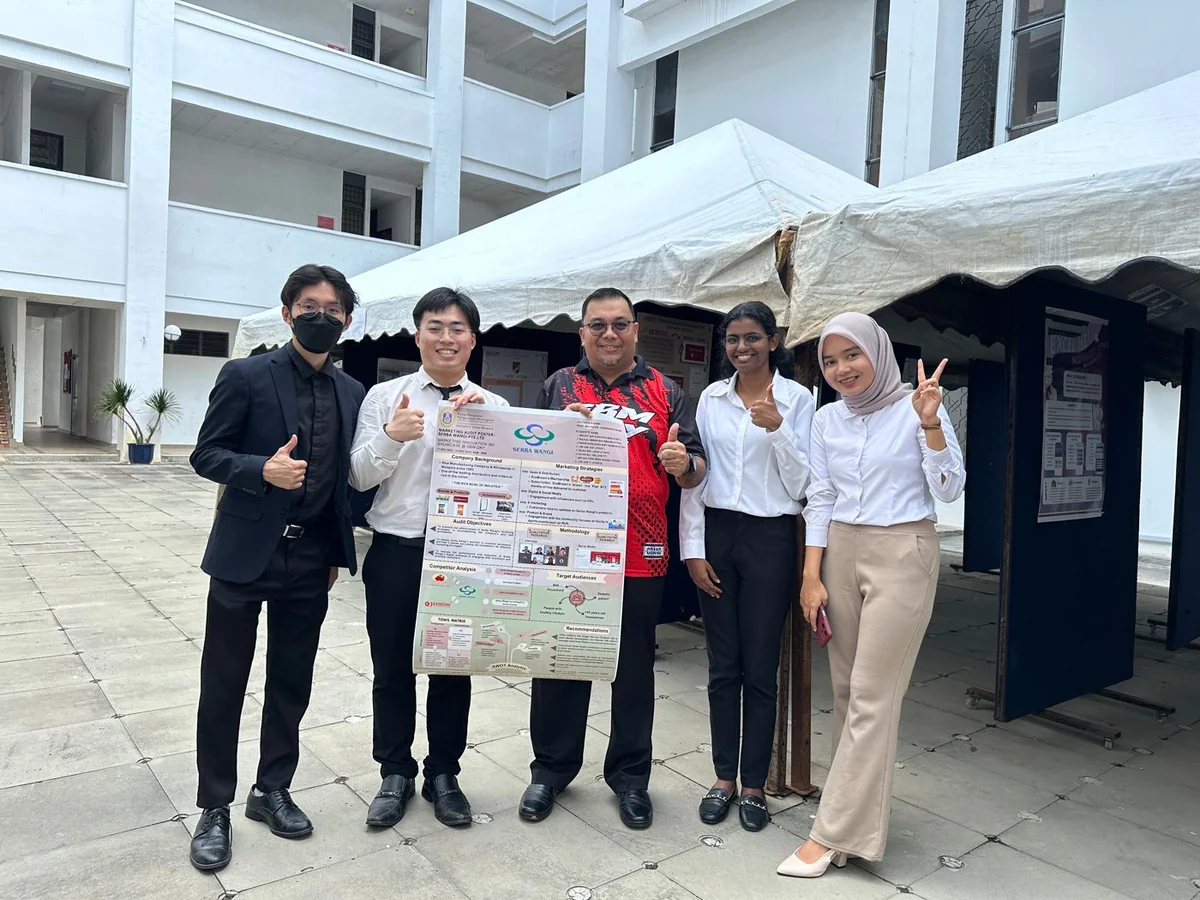
Serba Wangi marketing audit
Applied team project · UUM Marketing Seminar · Report submitted December 2023 Role: student team leader
How could Serba Wangi reach more customers and improve its digital marketing?
We reviewed the company’s marketing strategy through an interview, competitor and price comparisons, and a review of its online presence.
Presenting the marketing audit poster with the project team.
Recommendations
The interview highlighted the company’s use of Facebook and plans to reach younger customers. We used a TOWS analysis to develop recommendations on market expansion, digital marketing and sustainability.
The team received first place in the 2024 Marketing Seminar Audit Report Competition.
PhD research interests
I am seeking PhD opportunities in Australia in consumer behaviour and technology adoption. I would like to study how perceptions of safety and competence affect consumers’ use of new service technologies.